

Hey there! I'm a supplier of Hammerhead Boom Cranes, and today I wanna chat about how the boom angle of a Hammerhead Boom Crane impacts its load - carrying capacity.
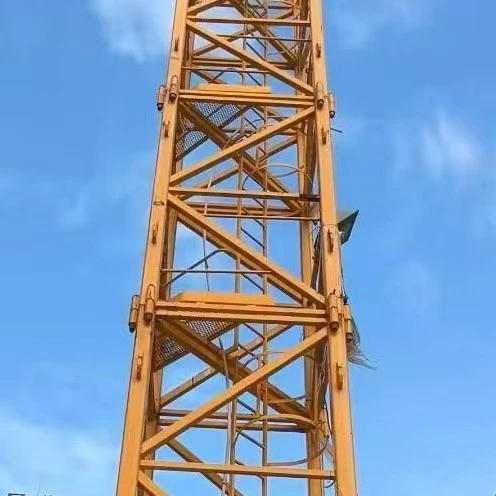
First off, let's get a basic understanding of what a Hammerhead Boom Crane is. It's a type of tower crane that's got a horizontal jib (the boom) and a counter - jib. The name "hammerhead" comes from its shape, which resembles a hammer. These cranes are commonly used in large construction projects, like building skyscrapers or bridges. You can check out more about Hammerhead Tower Crane on our website.
Now, let's dive into the boom angle. The boom angle is the angle between the horizontal plane and the boom of the crane. It plays a crucial role in determining how much weight the crane can lift.
How Boom Angle Affects Load - Carrying Capacity
When the boom is at a relatively low angle (close to horizontal), the load - carrying capacity of the crane is usually lower. This is because, at low angles, the forces acting on the crane are distributed in a way that puts more stress on certain components. For example, the tension in the cables and the bending moment on the boom are higher.
Let's say we've got a situation where we're trying to lift a heavy load with the boom at a low angle. The load creates a large moment around the base of the boom. This moment tries to bend the boom and can cause excessive stress on the crane's structure. As a result, the crane manufacturer usually sets a lower maximum load limit for low boom angles to prevent structural failure.
On the other hand, when the boom is at a higher angle (more vertical), the load - carrying capacity generally increases. At higher angles, the forces are more favorably distributed. The tension in the cables is reduced, and the bending moment on the boom is also decreased. The load is more effectively transferred to the vertical mast of the crane, which is designed to handle compressive forces well.
For instance, if you're lifting a load with the boom almost vertical, the load is essentially pulling straight down on the mast, and the mast can handle this type of force much better than the bending forces created at low boom angles.
The Science Behind It
To understand this better, we need to look at some basic physics. The load - carrying capacity of a crane is related to the equilibrium of forces acting on it. When a load is lifted, there are several forces at play: the weight of the load, the tension in the cables, the reaction forces at the base of the crane, and the internal forces within the boom and mast.

The moment equation is a key concept here. The moment of a force is the product of the force and the perpendicular distance from the line of action of the force to the pivot point (in this case, the base of the boom). At low boom angles, the perpendicular distance from the load to the base of the boom is large, resulting in a large moment. At high boom angles, this perpendicular distance is smaller, so the moment is reduced.
Another factor is the stress distribution within the crane's structure. Different materials used in the crane, like steel, have specific stress limits. At low boom angles, the stress in certain parts of the boom and cables can exceed these limits if the load is too heavy. By adjusting the boom angle, we can keep the stress within the allowable limits and ensure the safety and stability of the crane.
Practical Considerations on Construction Sites
On a construction site, the operators need to be very aware of the boom angle and its impact on the load - carrying capacity. They have to plan their lifts carefully, taking into account the weight of the load and the available boom angles.
For example, if they need to lift a very heavy load, they might first raise the boom to a higher angle to increase the load - carrying capacity. Then, once the load is safely lifted, they can adjust the boom angle as needed for positioning the load at the desired location.
It's also important to note that weather conditions can affect the relationship between boom angle and load - carrying capacity. Strong winds, for instance, can create additional forces on the crane and the load. At low boom angles, the wind can have a more significant impact on the stability of the crane, further reducing the safe load - carrying capacity.
Comparing with Other Types of Cranes
We can also compare the Hammerhead Boom Crane with other types of cranes, like the Hydraulic Tower Crane and the Jack Up Tower Crane.
Hydraulic Tower Cranes use hydraulic systems to lift and move loads. They often have different boom designs and operating characteristics compared to Hammerhead Boom Cranes. The boom angle in a Hydraulic Tower Crane can also affect its load - carrying capacity, but the way the forces are distributed and the stress analysis might be different due to the hydraulic components.
Jack Up Tower Cranes are designed to be self - erecting and can be adjusted in height. Similar to Hammerhead Boom Cranes, the boom angle is an important factor in determining their load - carrying capacity. However, the overall structure and the way they handle loads might vary, and the operators need to be familiar with the specific characteristics of each type of crane.
Importance of Regular Inspections and Maintenance
To ensure that the crane operates safely and the boom angle affects the load - carrying capacity as expected, regular inspections and maintenance are crucial. Over time, the components of the crane can wear out, and this can change the way the crane responds to different boom angles.
For example, if the cables are frayed or the joints in the boom are loose, the stress distribution within the crane can be altered. This might lead to a situation where the load - carrying capacity is not what it should be based on the boom angle. Regular inspections can detect these issues early, and maintenance can be carried out to keep the crane in good working condition.
Conclusion
In conclusion, the boom angle of a Hammerhead Boom Crane has a significant impact on its load - carrying capacity. Understanding this relationship is essential for crane operators, construction site managers, and anyone involved in crane operations. By carefully adjusting the boom angle, we can ensure the safe and efficient lifting of loads.
If you're in the market for a Hammerhead Boom Crane or have any questions about how boom angle affects load - carrying capacity, feel free to reach out. We're here to help you make the right choice for your construction projects.
References
- "Crane Engineering Handbook" by John Smith
- "Structural Analysis of Tower Cranes" by David Johnson
- Industry standards and guidelines for crane operation and safety.


