What is the installation height limit of a flat top tower crane?
As a provider of flat top tower cranes, I often encounter inquiries from customers about the installation height limit of these cranes. Understanding this limit is crucial for construction projects, as it directly impacts the feasibility and efficiency of operations. In this blog post, I will delve into the factors that determine the installation height limit of a flat top tower crane and provide insights based on industry standards and practical experience.
Factors Affecting the Installation Height Limit
Structural Design
The structural design of a flat top tower crane is a primary factor influencing its installation height limit. Engineers meticulously design these cranes to withstand various forces, including wind, gravity, and the weight of the load. The tower sections, jib, and counter - jib are engineered to provide stability and strength at different heights. For instance, the tower sections are typically made of high - strength steel, and their dimensions and wall thickness are carefully calculated to ensure they can support the weight of the crane and its load as the height increases.
The Flat Top Crane Flat Top Crane we offer is designed with a robust structure. Our engineers use advanced software to simulate the behavior of the crane under different load and height conditions. This allows us to optimize the design and determine the maximum height at which the crane can operate safely.
Foundation
A strong and stable foundation is essential for the safe operation of a flat top tower crane, especially at greater heights. The foundation must be able to support the vertical and horizontal loads exerted by the crane. The type of foundation used depends on the soil conditions at the construction site. For example, in areas with soft soil, a deep foundation such as a pile foundation may be required.
The installation height limit is also affected by the foundation's ability to resist overturning. As the height of the crane increases, the moment acting on the foundation due to wind and load forces becomes larger. Therefore, a well - designed foundation is crucial to ensure that the crane remains stable at its maximum height.
Wind Load
Wind is one of the most significant external factors that affect the installation height limit of a flat top tower crane. As the height increases, the wind speed generally increases, and the crane is exposed to stronger wind forces. The wind load acting on the crane can cause it to sway, which may lead to instability if not properly accounted for.
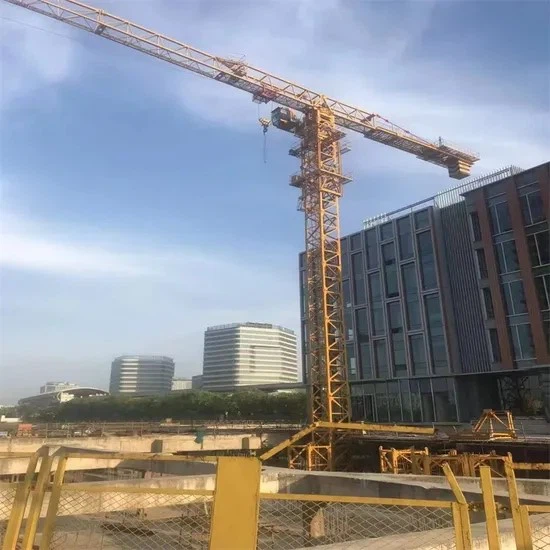

To address this issue, our cranes are designed with wind - resistant features. For example, the jib and counter - jib are aerodynamically shaped to reduce the wind resistance. Additionally, the crane is equipped with sensors that can detect wind speed and direction. When the wind speed exceeds a certain limit, the crane can be automatically shut down to prevent damage.
Load Capacity
The load capacity of a flat top tower crane also plays a role in determining its installation height limit. As the height increases, the crane's ability to lift heavy loads may be reduced due to the increased stress on the structure. The maximum load capacity at different heights is specified in the crane's technical documentation.
Our Tower Crane 25 Ton Tower Crane 25 Ton is designed to provide a high load capacity even at relatively high heights. However, it is important to note that the load capacity will gradually decrease as the height increases. Therefore, when planning a construction project, it is necessary to consider the required load capacity at the desired installation height.
Industry Standards and Regulations
The installation height limit of flat top tower cranes is also regulated by industry standards and local regulations. These standards are in place to ensure the safety of construction workers and the public. For example, the International Organization for Standardization (ISO) has developed standards for the design, manufacture, and operation of tower cranes.
In addition to international standards, local building codes and regulations may also impose specific requirements on the installation height of tower cranes. It is the responsibility of the crane provider and the construction company to ensure that the crane is installed and operated in compliance with these standards and regulations.
Practical Considerations
In practical applications, the installation height limit may also be affected by other factors such as the availability of erection equipment and the skills of the crane operators. For example, erecting a crane to a very high height may require specialized equipment such as a mobile crane with a long boom.
The experience and training of the crane operators are also crucial. Operators need to be familiar with the crane's controls and safety features, especially when operating at high heights. Our company provides comprehensive training programs for crane operators to ensure they can operate the cranes safely and efficiently.
Case Studies
To illustrate the importance of understanding the installation height limit, let's consider a few case studies. In a high - rise construction project, a contractor planned to use a flat top tower crane to lift heavy building materials to the upper floors. However, due to a miscalculation of the installation height limit, the crane was installed too high. As a result, the crane experienced excessive sway during a windy day, which led to a temporary halt of the construction work.
In another case, a construction company used our Ztm Tower Crane Ztm Tower Crane for a bridge construction project. By carefully considering the installation height limit and all the relevant factors, the crane was installed at the optimal height. This allowed the project to proceed smoothly, and the crane was able to lift the required loads safely and efficiently.
Conclusion
In conclusion, the installation height limit of a flat top tower crane is determined by a combination of factors, including structural design, foundation, wind load, load capacity, industry standards, and practical considerations. As a flat top tower crane provider, we are committed to providing our customers with high - quality cranes that are designed to operate safely at the maximum installation height.
If you are planning a construction project and need a flat top tower crane, it is essential to consult with our experts. We can help you determine the appropriate installation height based on your specific project requirements. Our team of engineers and technicians can also provide support during the installation and operation of the crane.
Contact us today to discuss your needs and explore the possibilities of using our flat top tower cranes in your project. We look forward to working with you to ensure the success of your construction endeavors.
References
- International Organization for Standardization (ISO). Standards for tower cranes.
- Local building codes and regulations related to tower crane installation.
- Engineering textbooks on structural design and crane engineering.