

Hey there! As a supplier of flat top tower cranes, I often get asked how the counterweight of these beasts works. It's a pretty interesting topic, and I'm excited to share all the details with you.
First off, let's talk about why a flat top tower crane needs a counterweight in the first place. These cranes are designed to lift heavy loads, sometimes weighing several tons, at great heights. Without a proper counterweight, the crane would tip over under the weight of the load. The counterweight acts as a balance, ensuring the crane remains stable and safe during operation.
So, how does it actually work? Well, the counterweight is typically located at the opposite end of the crane's jib (the horizontal arm that extends from the tower). When the crane is lifting a load, the weight of the load creates a moment (a turning force) around the crane's mast (the vertical tower). The counterweight creates an equal and opposite moment, which cancels out the moment created by the load. This allows the crane to remain in equilibrium and prevents it from tipping over.
The amount of counterweight needed depends on several factors, including the length of the jib, the maximum load capacity of the crane, and the height at which the load is being lifted. Generally, the longer the jib and the heavier the load, the more counterweight is required. Crane manufacturers use complex engineering calculations to determine the exact amount of counterweight needed for each specific crane model.
Now, let's take a closer look at the types of counterweights used in flat top tower cranes. There are two main types: fixed counterweights and adjustable counterweights.
Fixed counterweights are permanently attached to the crane and cannot be adjusted. They are typically made of concrete or steel and are designed to provide a specific amount of counterbalance. Fixed counterweights are simple and cost-effective, but they may not be suitable for all applications. If the crane needs to lift different loads at different times, a fixed counterweight may not provide enough flexibility.
Adjustable counterweights, on the other hand, can be adjusted to change the amount of counterbalance. This allows the crane to be used for a wider range of applications. Adjustable counterweights are typically made of steel and can be moved along the length of the counterweight beam. By adjusting the position of the counterweight, the crane operator can increase or decrease the amount of counterbalance as needed.
One of the key advantages of flat top tower cranes is their ease of assembly and disassembly. The counterweight system plays an important role in this process. Most flat top tower cranes are designed with a modular counterweight system, which allows the counterweights to be easily removed and transported. This makes it much easier to move the crane from one job site to another.
In addition to providing stability, the counterweight system also affects the crane's performance. The right amount of counterweight can improve the crane's lifting capacity, reduce stress on the crane's structure, and increase its overall efficiency. On the other hand, too much or too little counterweight can cause problems and even lead to accidents.

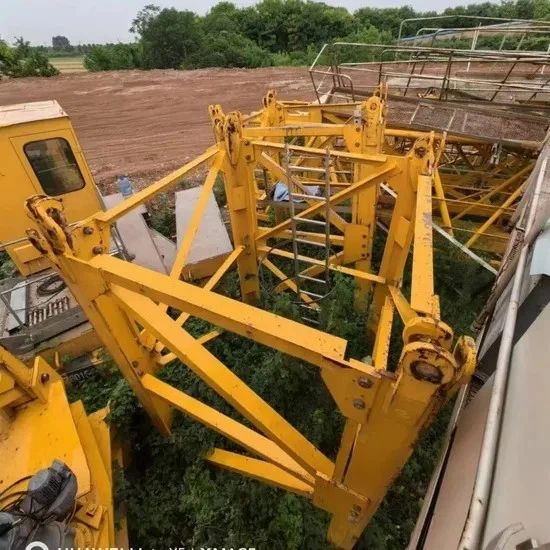
At our company, we offer a wide range of flat top tower cranes, including Potain Tower Crane, Dahan Tower Crane, and Sym Tower Crane. Our cranes are designed with the latest technology and engineering standards to ensure maximum safety, performance, and reliability. We also offer a comprehensive range of services, including installation, maintenance, and repair.
If you're in the market for a flat top tower crane, or if you have any questions about how our counterweight system works, please don't hesitate to contact us. Our team of experts is always ready to help you find the right crane for your needs and provide you with the support and guidance you need to keep your crane running smoothly.
In conclusion, the counterweight system is an essential component of a flat top tower crane. It provides the balance and stability needed to lift heavy loads at great heights safely. By understanding how the counterweight system works, you can make an informed decision when choosing a crane for your next project.
References
- "Tower Crane Handbook" by Frank J. DeStefano
- "Crane and Rigging Handbook" by Frank A. Diallo


